
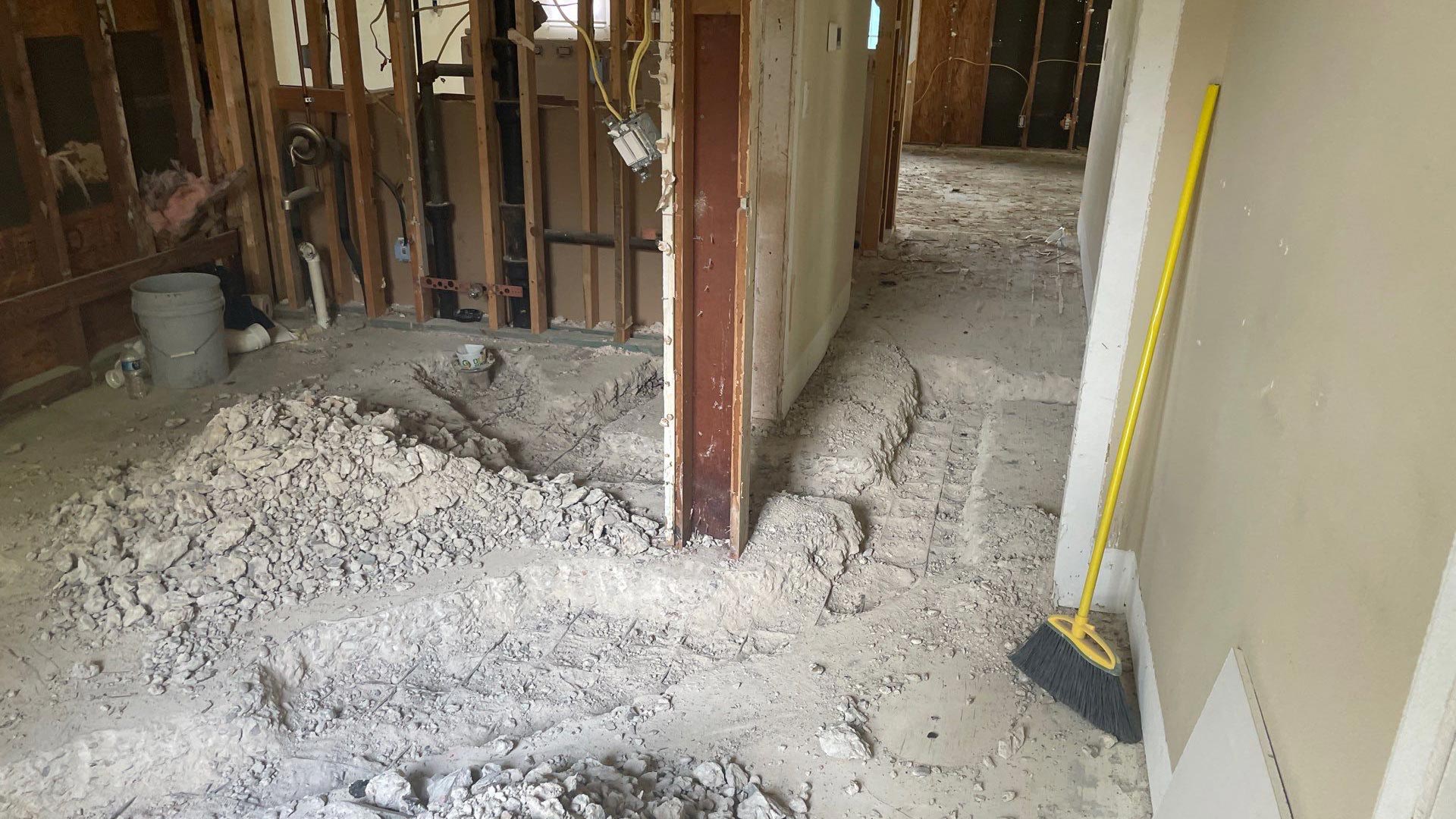
On my first remodel, I set aside ten percent as a contingency. It wasn't enough, not because the percentage was wrong, but because the GC's original budget was never realistic to begin with. I fired him, literally did most of the finish out work myself, and still ended up $60,000 over what he'd originally estimated.
No contingency fund survives a fundamentally dishonest bid.
That experience shapes how I think about contingency budgets. Here's an honest look at what they're actually for, how much to set aside, and the part most people don't tell you.
What a Contingency Budget Actually Is
A contingency budget is money set aside for costs you can't fully define when you start a project. Not a general buffer for overspending. Not a fund to upgrade finishes mid-project. Money specifically allocated for genuine unknowns.
The key word is unknown. On a recent project, there were legitimate questions about what an engineer and the City of Austin would require on the pier-and-beam foundation. We had work built into the budget, but because we couldn't define that portion of scope specifically, we allocated an additional $10,000 as a cushion for what we didn't yet know. That's a contingency: specific, justified, tied to an actual question we couldn't answer until we got further into the work.
Good contingencies are targeted. They exist because there are real questions the project can't answer yet, not because the bid was fuzzy.
The Two Types of Unknowns
There are things you can't see coming, and there are things you should have seen coming.
The first kind is genuinely unforeseeable. On a recent project, demo revealed that a previous homeowner had hidden a failing slab by building a faux subfloor over it. Nobody knew. One third of the foundation had to be removed and replaced with the house sitting on it. That's a significant, unexpected problem, and the change order came in around 3% of the total project cost. A major structural discovery, well-managed, and still only 3%. That's what contingency exists for: problems that were invisible until the walls came down.
The second kind is more common and more preventable. Consider a homeowner doing a full remodel with all new plumbing, HVAC, and electrical. If the scope is that complete, there's not much reason for a contingency on those systems. You're expecting everything to be replaced, so you can bid it specifically. The contingency should cover the parts of the scope you genuinely can't define, not the parts you already know.
Knowing Your Own Taste Is Also a Budget Issue
A client recently added a change order to remove old cast iron from their plumbing system. The existing system worked fine. It wasn't a surprise hidden in the walls. It was a choice they made mid-project after seeing what was there.
That's not what contingency is for.
Knowing upfront that you have expensive taste is its own kind of planning. If you're the kind of person who sees a nicer tile option mid-project and wants to upgrade, setting aside money for that possibility is smart. Just be honest with yourself that it's not contingency. It's a budget for decisions you haven't made yet.
The Dark Side of Contingency Budgets
Here's the part nobody talks about: contingency budgets can mask an imprecise bid.
Pricing a remodel is genuinely difficult. Some GCs use contingency as a slush fund for things they didn't fully account for when they were bidding the job. A large, vague contingency with no clear explanation of what it's covering is worth asking about. The best GCs carry contingency funds when needed, specified for questions they know they can't answer until the work starts.
Which leads to the most counterintuitive piece of advice: the lower the bid compared to others, the larger your personal cushion should be.
If the same project comes in at $475,000, $550,000, and $625,000 from three different GCs, and you choose the $475,000 bid, you should mentally prepare yourself for at least $75,000 in additional costs. The gap between the low bid and the next bid is telling you something. The low bidder may have genuinely found efficiencies, or they may have missed scope, made optimistic assumptions, or priced the job knowing they'd need change orders to make it work. Your contingency should reflect that uncertainty.
How Much to Set Aside
It depends on who you hired and how much uncertainty is actually in the project.
If you're going with the lowest bid, set aside at least half the gap between that bid and the next one. If the low bid is $475,000 and the middle bid is $550,000, your contingency should be at least $37,500, and probably more.
For everyone else, five to ten percent is a reasonable starting point. Five percent for a well-defined scope with a reputable GC. Ten percent if there's real complexity, older construction, or portions of the scope that genuinely can't be fully defined upfront.
On my second personal remodel, I set aside fifteen percent, with the explicit understanding that my rough estimates weren't accounting for everything and I was comfortable with that uncertainty. Knowing what you don't know is half the battle.
One more thing worth checking: many GCs build contingencies into their bids. It may be itemized as a line item or folded into the overall number. Ask. If there's already a contingency in the bid, you may not need to layer another one on top, or you may decide the existing one isn't large enough given what you know about the scope.
The Honest Answer
Contingency budgets are most useful when they're specific, justified, and sized appropriately for the actual unknowns in your project, not as a general comfort fund or a cover for an imprecise bid.
If you're not sure how much uncertainty is actually in your scope, or whether the contingency in your GC's bid is reasonable, that's exactly the kind of question an independent consult can help you think through before you sign. So is understanding whether your bids are actually telling you the full story on what the project will cost.